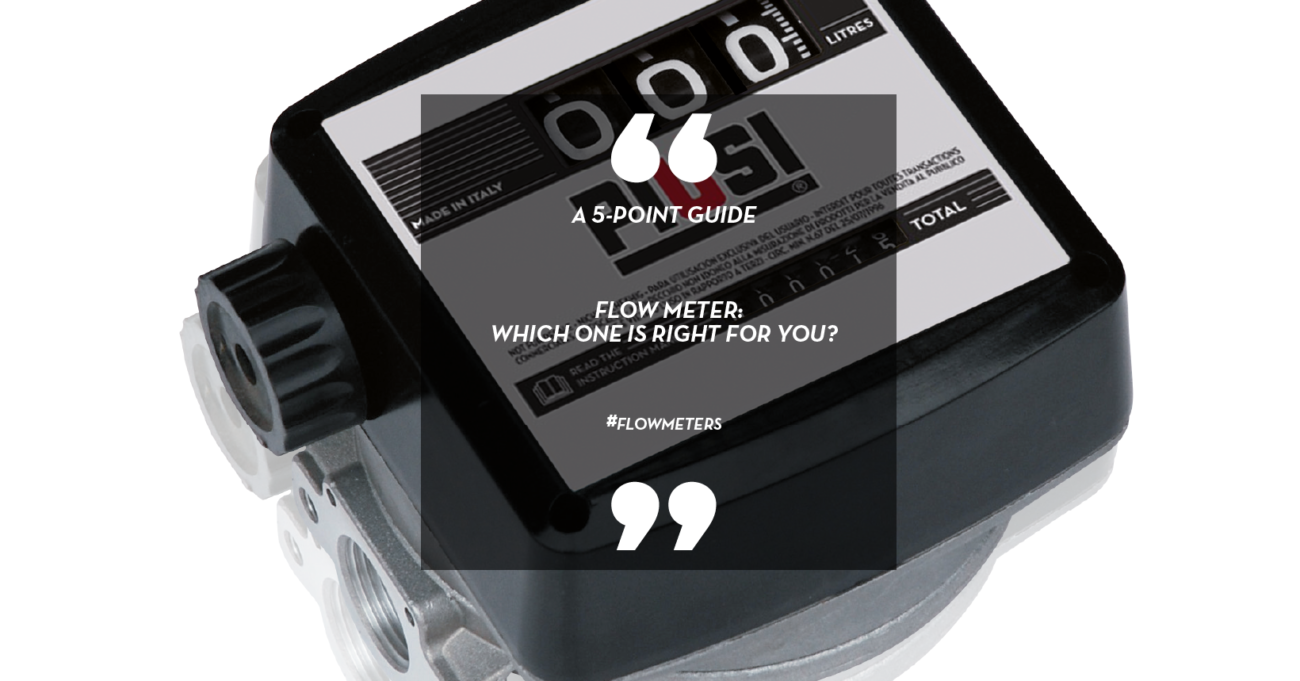
Have you already dispensed enough oil? How much fuel are you using? Consumption? These are important questions within the fluid transferring context; which can be answered in different ways. The most direct one is using a flow meter. A technological device that allows you to measure the quantity of fluid which has been dispensed.
There are several versions of meters dedicated to the different application sectors. A very intricate maze of variables that often make the choice complex. For example, PIUSI has released to the market more than 20 different models of flow meters.
For each fluid you have to dispense there is a mechanical or digital flow meter. There are also pulser meters available. There is also MID certified equipment.
How to choose, then? Here are some tips.
1. Fluid
The first thing to do is to identify the fluid you need to dispense and limit the choices to the meters suitable for that fluid. Each liquid has specific hydraulic and mechanical properties: viscosity, pressure, temperature, corrosion, cleanness, consistency…. thus a dedicated meter will be necessary to be able to correctly interact with these features.
On the PIUSI website home page it is possible to filter the meters manufactured by the Company accordingly to this vision: just select the context (Fuel/AdBlue® or DEF/Lubrication) on the K33 simulator, filter the category METERS and search. The result is a list of available meters for the sector.
2. Installation
Once you have defined the application field, the second step is the installation. In which context are you going to use the meter? Where will it be installed? Therefore, design aspects – such as pipe dimensions, material, working pressure… - as well as all aspects related to the data transmission will be taken into consideration. Moreover, all possible “environmental interference” has to be considered: for example, if the meter will be installed in potentially explosives atmospheres that require ATEX/UL certified equipment.
3. Precision, accuracy, repeatability
Accuracy indicates how close the measurement is to the real value. While precision is the value that indicates the difference between those measurements.
Speaking of accuracy, this is a percentage value that indicates how much the measured data is consistent with the calibration curve. For example, when the indicated precision is ±1% it means that the meter can give a result that is 1% higher or lower than the calibration curve. Generally, the lower the percentage is the more precise the meter is. However, the data is influenced by external factors related to chemistry and the condition of the fluid during the dispense.
On the other side, repeatability indicates how many times the same result is obtained at the same conditions. In other words, the result obtained should always be the same at the same conditions. For example, when repeatability is ±0,2% it means that the measurement is 0,2% lower or higher than the result obtained in the previous measurement; keeping the same conditions.
How are these values related? Simply put: a meter can be more or less precise than another one – not all applications require the maximum precision – but, surely, data has to be repeated at the same precision as itself during similar conditions. We should say that repeatability is the basis on which precision operates.
All PIUSI meters have a repeatability value between ±0,1% / ±0,3%.
4. Working temperature and pressure drop
Operation in very hot or cold atmospheres has to be considered as an influential variable as well as the maximum and minimum working temperature of the meter. Outside of this range, the meter may suffer breakages, changes to accuracy and imprecisions.
Pressure drop, which is intrinsic to the system, is the decrease of pressure within the plant and it is generated from different factors such as dispensing speed, viscosity, temperature… When you are choosing a meter, it is always important to consider this data; which is detailed on the technical sheet of the product.
All technical data of PIUSI meters are published online here.
5. Mechanical or electronic flow meter? Pulser or MID?
Moreover, the electronic meter translates this measurement into easily readable data on the display through an electronic card with microprocessor that allows the management of the display and the calibration of the flow meter.
Instead, the pulse meter works on impulses. Generally, an impulse is a mechanical contact that is generated each time the sensor is hit. An impulse corresponds to an input on this sensor. If the flow rate increases, the impulse will be faster and the time between one and the other will shorten. The PIUSI pulsers generate a clean contact (Reed switch), single channel Max 28 V Ac / dc 100 mAmp.
If a metrological MID certified measurement is required, a flow meter with that specific certification has to be chosen.
We hope our tips are helpful in choosing the best meter for you. For any further information you may need, contact our local distributor or our Sales Area Manager for a personalized advice.